Source: View original notebook on GitHub
Category: Machine Learning / Learn ML
MultiLayer Perceptron/ (Feed/Deep) Forward (Architecture/Net)
<img src="https://raw.githubusercontent.com/jugshaurya/Machine-Learning/master/Learn%20ML/04-Neural%20Network/images/neural_net.gif" alt="Perceptron" width= 450 />
Multilayer means :
- 1
input layerwith neurons equal to our inputs x1,x2,x3,x4...`
n hidden layers,each with as many neurons we want .
1 output layerwith neurons equal to the number of classes we want to predict.
Note: input layer is not counted while saying x-layered network.
2 Layer Network
- Two layers : 1 Hidden + 1 output
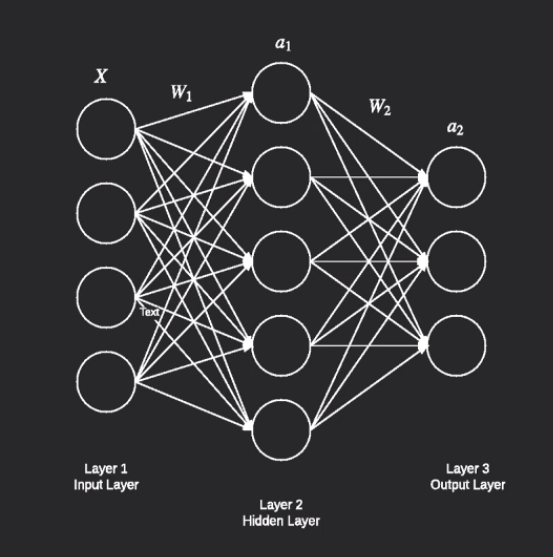
In the above diagram : we are going to learn the weightes assocated with this neural network.

   for hidden layer:
    ------------------

    W1 is the matrix : shape(4 X 5) as each neuron in hidden layer recieves 4 inputs hence 4 weights per neuron.
    b1 is vector : shape(5 X 1) ;1 per neuron

    for output layer:
    ------------------

    W2 is the matrix : shape(5 X 3) as each neuron in output layer recieves 5 inputs hence 5 weights per neuron.
    b2 is vector : shape(3 X 1) ; 1 per neuron

Goal : -> learn w1,w2,b1,b2( 4*5 + 5*3 + 5 + 3 = 43parameters)
3 Layer Network
- Three layers : 2 Hidden + 1 output

Note: hidden layer increses , input and output layer always remains 1 and 1
 : more layered network means more complex functions
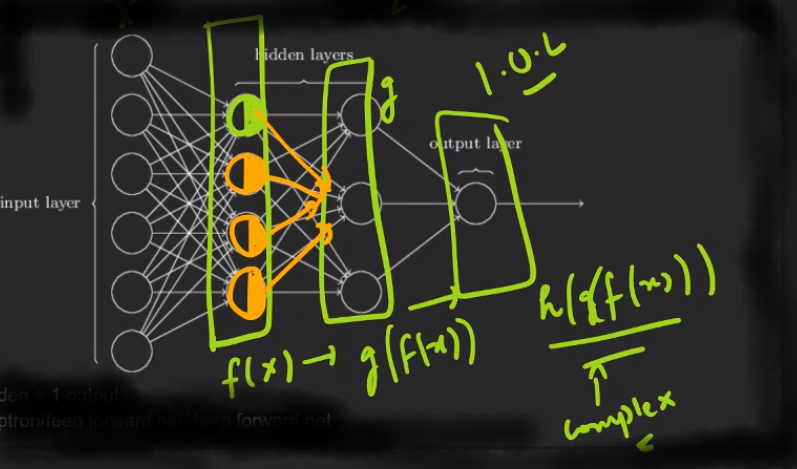
Note: Each neuron in hidden layer or output layer is going to act as a biological neuron hence taking inputs -> generting Z as Weighted sum of inputs with bias included and then output of particular neuron is g(Z) which will act as input for next layer neurons
Passing data to Neural Network (Forward Propagation)
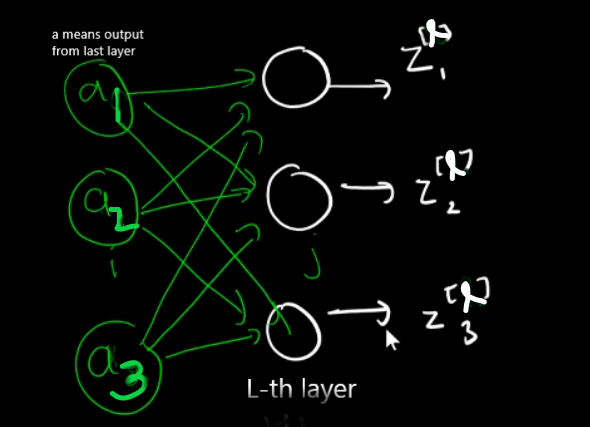
Z is the inner part of g(Z)
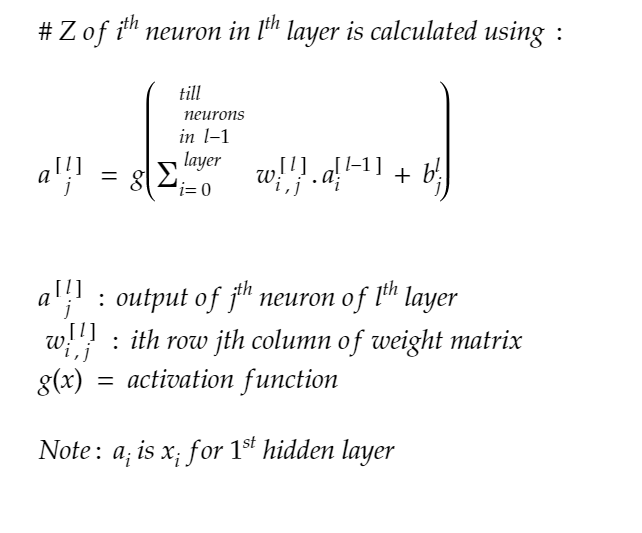
Output of every Layer
Note:
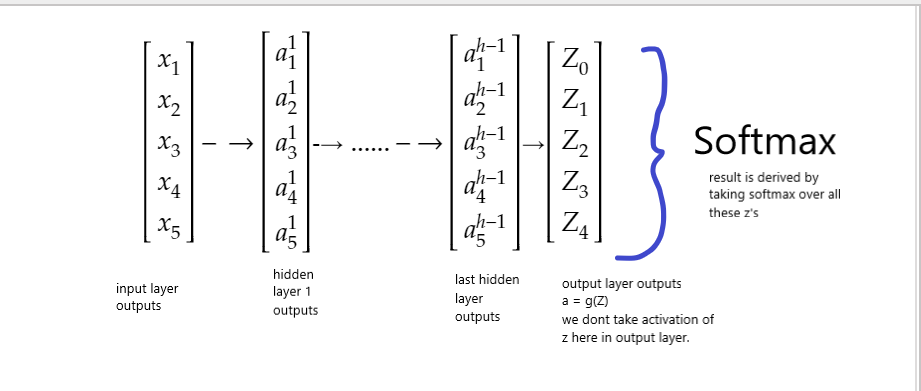
In output layer we will not use g(z) or activation function we find out z = weighted sum +bias and then take softmax over all these z's
Example : -